Step 1. The First Half of Season 1

My first experience with Twin Peak, my introduction, was the, bar-for-bar, inclusion of the Red Room in Soul Eater. Take a look at this shit, it's not subtle:
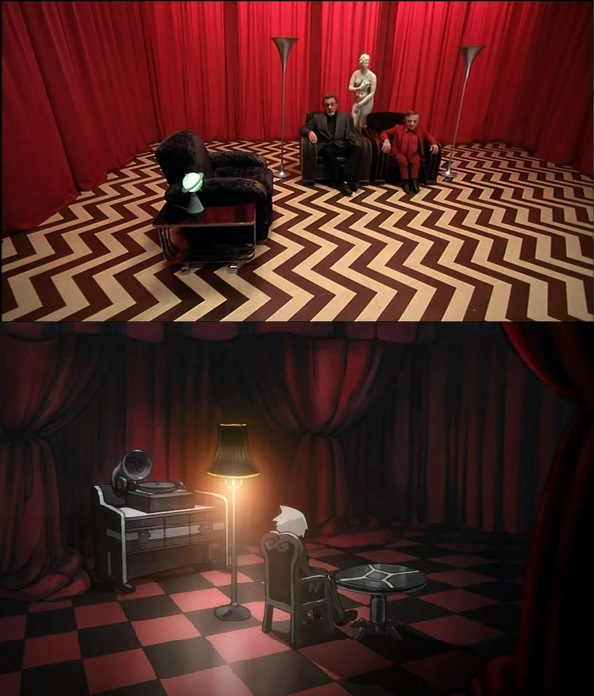
Perhaps the main difference between the two depictions is the replaceal of The Man from Another Place with Little Ogre. Now, in my opinion its a little tasteless to replace the man from another place with a literal demon, but that's not really my business.
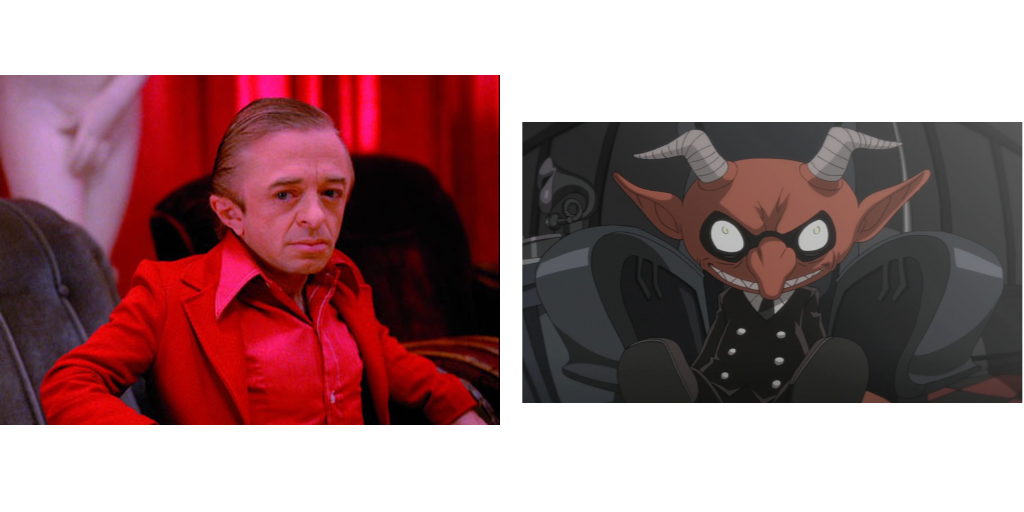
Though, in fairness, Little Ogre plays a different role, representing madness and the allure of power, this isn't about Soul Eater.
Before we get into it, let's discuss the goal of the first watch through: vibes. In this moment, we're playing the vibe inspector, the vibe archeologist - unearthing, dusting off, and taking a studious look at the vibe of the series. Notably, this watch is not about anthropology, there is no piecing together, no theorizing, no big-time narrative but the one we're watching.
Twin Peaks is extrapolated from a traditional, a classic, murder-mystery setting. Small, rural, sleepy town is rocked by the murder of a local with the investigation turning up a seedy and sordid underbelly resting just below the pretty veneer. The briefest possible summary of the events of the first half of the season is: local girl is murdered, discovered, another woman wanders in from the mountains, the FBI rolls up, they do what can charitably be called investigation, local kids are doing drug shenanigans, everyone in the town has an affair, and Jesus Christ that kid's forehead is huge.
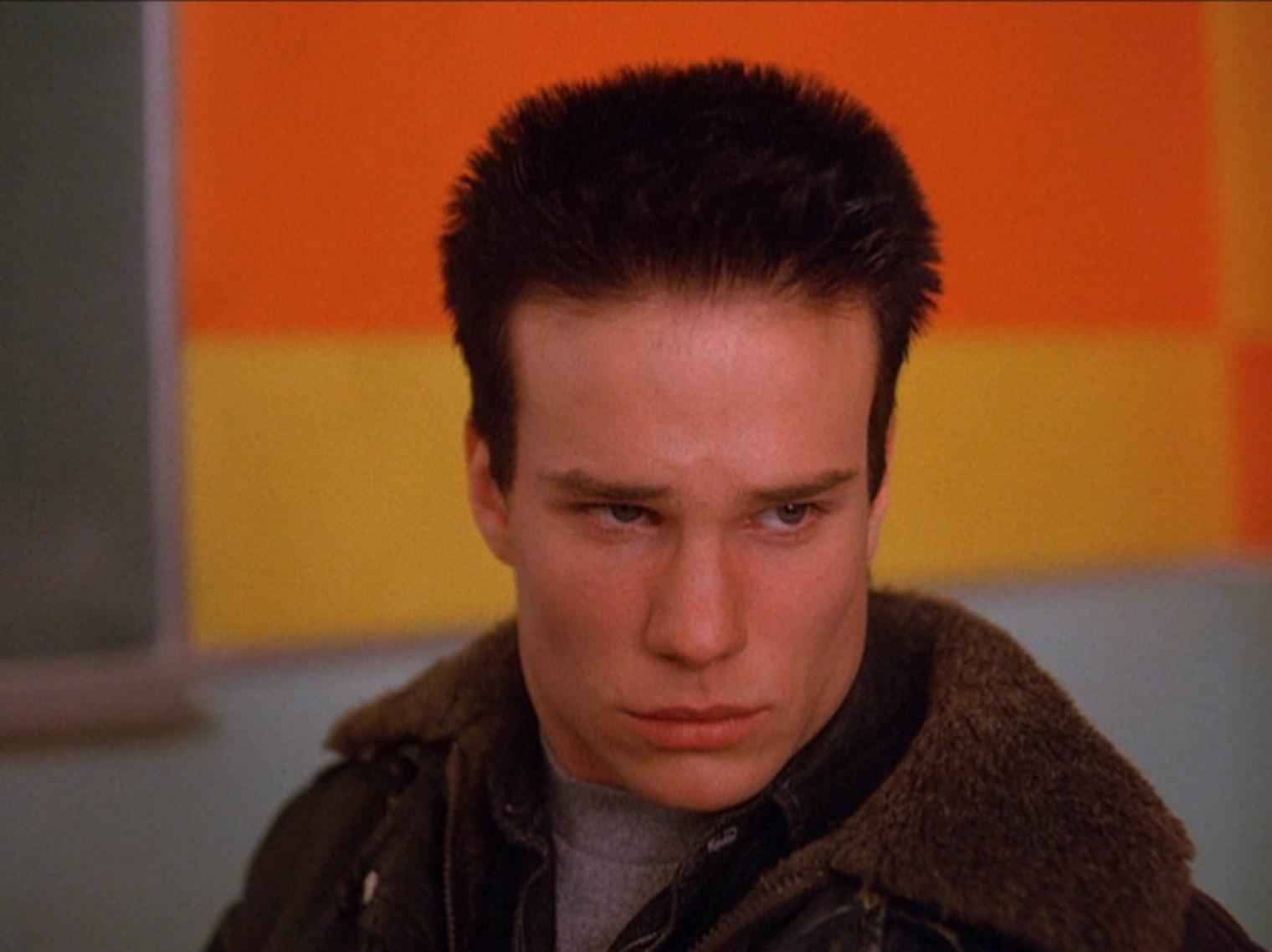
Like, come on, that's not even edited, it just looks like that the whole time. With the events established, let's take a look at some of the individual power pieces and players in this story:
Twin Peaks (the town): Twin Peaks is an idealized town from some Reaganite sitcom - the crime rate is low, your neighbors are your community, everyone knows everyone, there are NO black people allowed. If the sign in the intro is to be believed, there are 50k-some-odd-muthafuckas in this town, but we see so remarkably few of them, and really so little of the town itself, it's easy to believe there's only a few hundred or thousand jons total. The size of Twin Peaks is strange, with 50k people it is certainly large enough to have things like its own police department, a coroner, a Joel Osteen type megachurch. Yet, there's only the sheriff and his two deputies, one which sucks so much shit at his job he ought be fired by cannon into the sun. The same doctor who must have delivered all the residents also does the autopsies. Seemingly the only psychotherapist is evidently the biggest pervert in creation. The #1 freak and pervert. It's no coincidence that Twin Peaks is in the Near-Canada Pacific Northwest (NCPNW) where the beautiful veneer is explicitized as that of nature. Natural beauty is often allowed, even insisted, to be haunting, desolate, sinister in its silence and power. The masque of this town isn't rotten, but damp - inexplicably damp - and it covers not a scar but a new and different face, wrong in some way. It is in the town itself, perhaps, that the strange logic of Twin Peaks is most apparent, and it feels like it's playing you for laughs.
Sheriff Harry S. Truman: AKA yellow fever patient zero. Look, we can't start on this guy any other way than acknowledging his game, locked down the only baddie with a pixie cut in a hundred miles. Generational. A widow too, humina-humina. Sheriff Harry, Sharry, is the kind of cop people think about when they say "not all cops". Kind, gentle, handsome, out of his depth, but never bumbling. Willing to use violence to get his way, but only against jerks - never you, I promise. A man primarily driven by justice and then kindness. He is one of the few characters to not have his virtue explicitly undermined in these first episodes. Sure, he can't solve the case, but it's clear the case can't be solved without him either. Sharry is most interesting for his relationship with Agent Cooper, where the two feel almost like a comedy duo, with Sharry as the straight man. A regular Abbot and Costello of murder. His reaction to Agent Cooper's antics (fatherly bemusal, occasional genuine affection) is the perfect foil. His lack of skepticism to Cooper's more arcane methods is strange, at first, then increasingly a sign he may know more than he's letting on.
Special Agent Dale Cooper: This guy is fresh off the lot, he's still got the new car smell and everything. The way Agent Cooper engages with the world around him gives the impression the FBI keeps a room full of Sherlock Holmes-Bots in some warehouse somewhere until they're needed. He's genuinely not been outside before. Cooper's naivete toes that line between creepy and charming, if the characters around him were to treat him with anything other than well-meaning deference, he'd reverberate through Twin Peaks like a malicious drum beat. At his most malevolent, Cooper seems willing to let Audrey Horne blow her whole shit up just to get a little information. It's in these interactions Cooper seems most cruel, he can tell the poor thing is in love with him, and choose investigative value over her well-being without thinking too hard. To be clear, this is my #1 guy. Cooper has elements both of Shakespearean Jester with esoteric knowledge beyond explanation and hard-boiled detective, complete with internal monologue on the outside. Instead of voice over, Cooper details case notes, personal thoughts, and high-level musing to "Diane", a seeming secretary on the other side of his tape recorder. It is unclear if Diane ever speaks back. Now, if we allow ourselves to put on our theorist hat, just for a second, Diane may be a stand-in for Diana, Roman goddess of the hunt. Which would be Cooper's second connection to a Roman Deity in these first four episodes, with a statue of Venus residing in the Red Room. Odd, let's keep an eye on this one fellas.
Bobby Briggs: Captain of the football team, drug dealer, serial adulterer all before his second decade. Frankly, he's doing too much. With Bobby, we begin to get into the category of characters who seem like misunderstood soviet hallucination. "Even the captain of the football team, the American paragon of virtue, runs drugs and corrupts the community". Bobby also begins the long chain of dudes who think they're scary but don't realize they are just standing in front of a scarier dude. For Bobby, this is Leo Johnson (who doesn't really merit his own section, at least yet), a man who's menace is, so far, entirely derived from his mistreatment of women and children. Bobby's main characteristic is that he's angry for no as-of-yet-discernible reason. He's got engaged, caring parents (including, inexplicably, a highly decorated army officer always in uniform), two girlfriends, a ride-or-die bestie, by rights he should be chilling 100. Yet, he operates mainly from a place of seething anger, best seen when he interrupts Laura's funeral in an, not entirely unkind, outburst, "we all knew she was in trouble." With regards to Laura, Bobby is also the only character who doesn't seem to be able to intuit that Laura is dead from the first mention of her name, as if he's somehow inoculated to the doom laying over the town.
Donna Hayward: Laura's best friend, but not confidante, Donna is the girl next-door to Laura's prom queen. She's sweet and kind and loyal, but a little too unbothered on a spiritual level by the gruesome murder of her best-friend. Sure, she's doing what she can to investigate, but in some way this seems like an excuse to see James, and more broadly, something she's doing more out of loyalty than love. She is also nominally supposed to be dating Mike Nelson, Bobby's ride-or-die, which would complete the wholesome surface level, best-friends and town-sweethearts all dating one another in some big pile. Though this relationship isn't paid much mind, Mike has one threatening conversation with Donna's father and then seems to forget about the whole relationship pretty quickly. Of all the characters so far, Donna feels most like a vehicle to me, when the plot has no other way to move forward, we get to see what Donna's up to.
Audrey Horne: Perhaps in totality the most interesting character in the series. Audrey Horne is primarily a malevolent trickster force who is activated and focused towards Greater Good™ by an intense desire for an older man. Between her destruction of her freak-ass father's business interests and her horned-up justice crusade she is the most effective bulwark against the town's evil. Dancing to her own theme (which sounds shockingly like Pyrite Town's theme from Pokemon XD Gale of Darkness) and actively espionaging her father easily secures her the Turnip One Million Real Shit character award for this leg. Audrey's most important contribution, though, is making clear that a femme-fatale type character deprived of any lesbianism can only be ever read as sinister.
James Hurley: What a thing, what a thing to have a baby-James Dean just rolling around your town. You could run into him at any time, you're never safe from those sad, brooding eyes. Like Sharry, James never has his moral purity explicitly compromised by the narrative. Despite being Twin Peak's most prolific serial incubus. This man is just clearly addicted to seducing girlfriends, and never once does the show question this behavior. In fact, his seductions are presented as good and right, these women love him more than their chud boyfriends. After all, he is kinder, gentler, purer of heart: he rides a motorcycle and looks like he's just a second from crying all the time, but almost never does. James Dean summoned from across the veil to be given one final chance to crush as much puss as possible. In form, James is Laura's second chance, given human flesh. He offers an alternative to that which is killing Laura, an off-route, a chance to hop on a motorcycle and ride away into the sunset, still alive if a little bored. Alas, though, it was James and Donna who were actually falling in love during this final second chance. It's Laura who dies, and Donna who get the other path.
Laura Palmer: Last one, then we're gonna hit a rapid fire round. Maybe every other hour, we have a small experience, something innocuous with no real significance. Yet, someone pops into your mind, your heart feels what it feels when that person is near, a little warmth in your toes. Sharing that experience, a fat-ass squirrel perhaps, will solidify it in your heart and mind. Take some passing moment, one out of the infinity we never notice, and transmute it into something cherished. Something somehow more real, more important, than the big memories. Laura is that person. So, what happens to that feeling when it has nowhere to go? When that person you feel in-between your soul and heart, no, a little to the left, is gone, when you can't reach them? This feeling, an opportunity to bask in the the warmth and worth of life, instead withers. Love loses it's hands and becomes grief. The same grief you know, but rotated a few degrees, so it puts new edges in the hole in your heart. Laura was the busiest bitch in the whole world, how on earth did she have time for all that?
The "Good?" Guys:
Deputy Andy: This guy sucks, both at his job and as a person. This crybaby should've gone to Vietnam and learned some manners.
Deputy Hawk: Not much to say, hasn't been a big factor, he's a good tracker(?) not sure how to feel about that one.
Ed Hurley: Gentle giant ass. The show wants you to think he's some saint for putting up with Nadine, but he knew what he was getting into when he married her.
Dr. Will Hayward: Seems like a good guy. I think he'd probably prescribe me HRT and might just kinda listen to what I want, since he feels out of his depth. 10/10.
Leland and Sarah Palmer: They're here, the madness seems to be encroaching, but I think they'll be fine. I'm dubious, though, of Leland, he seems to be Ben's right hand man, does he not know about all the crime? Seems likely he's either stoopid or complicit.
Pete Martell: Boy this guy just loves fishin and 2x4s and 4x8s. If anything happens to this guy I'm sending a strongly worded letter to a random US embassy.
Log Lady: I love her, I would care for both her and her log tenderly, not even romantically. Just out of duty.
The Bad Guys:
Ben Horne: This dude is a freak on a stick. The way he ate the sandwich Jerry brought him should be enough for him to catch a charge. Despite all the crime and sex and weird creepy nature, he does have humanizing moments. Him picking up Laura from the morgue was enough to give me a moment's pause.
Jerry Horne: Some men need castration more than therapy.
Leo Johnson: As said before, scary compared to an 18 year old, I'd like to see him in streetbeef scrapyard vs. gash and see how long he'd last, though.
Catherine Martell: Cougar energy and cooking the books? give her my number it's (719) 387.....
Dr. Lawrence Jacoby: Now, I don't know enough about him to really label him a bad guy... but he's clearly and obviously the town pervert in a way that DOES NOT sit right with me. For that alone he's enemy numba 1, persona NONgrata muthafucka.
If your fave has not yet appeared... I am sorry with my whole heart. Any characters not yet discussed have not made enough of an impression, and will be discussed once they vibe out hard enough.
The Affairs: Every single person in this town is cheating, every single one. Here I'm going to try to summarize the affairs as they have appeared so far.
Laura Palmer and James Hurley (on Bobby Briggs): Laura is cheating on the captain of the football team with Baby James Dean. She knows James loves her (arguable, given the Donna impact) but seems bored by him.
Donna Heyward and James Hurley (on Mike Nelson, arguably Laura Palmer): This one could be a triple double for James. Donna is cheating on Bobby's buttboy Mike, also with James. Again Mike seems to forget about this pretty quickly. It could be argued that James is cheating on Laura, given he and Donna hook up like the day Laura dies and Donna later describes James and Laura's relationship as "[Donna] and James were the ones falling in love the whole time". Not my business.
Bobby Briggs and Shelly Johnson (on Laura Palmer & Leo Johnson): It's usually not smart to crack your coke supplier's wife on the side, but what do I know. Bobby is big for his Briggches and thinks he could kill Leo. Leo deserves it. No further comment.
Ben Horne and Catherine Martell (on Sylvia Horne and Pete Martell): This is both pleasure and business, though it seems to be business for Ben and pleasure for Catherine. Seems to be a long-running affair, and maybe Ben was more into it when they were young, but he's clearly the Leo DiCaprio type.
Big Ed Hurley and Norma Jennings (on Nadine Hurley and yet-to-be-revealed parolee): Another long running affair, it's clear these two always loved one another, but did a ships-in-the-night routine or something and Ed married Nadine out of a weird sycophantic pity. Norma's parolee husband seems like a promising X-Factor, let's see what this guy can do.
Sheriff Truman and Josie Packard (on No One, this one's fine): Okay, this one isn't really and affair, but it is secret and that counts for something. Again, props to the sheriff's game on this one, its a real heads up play by all available indicators.
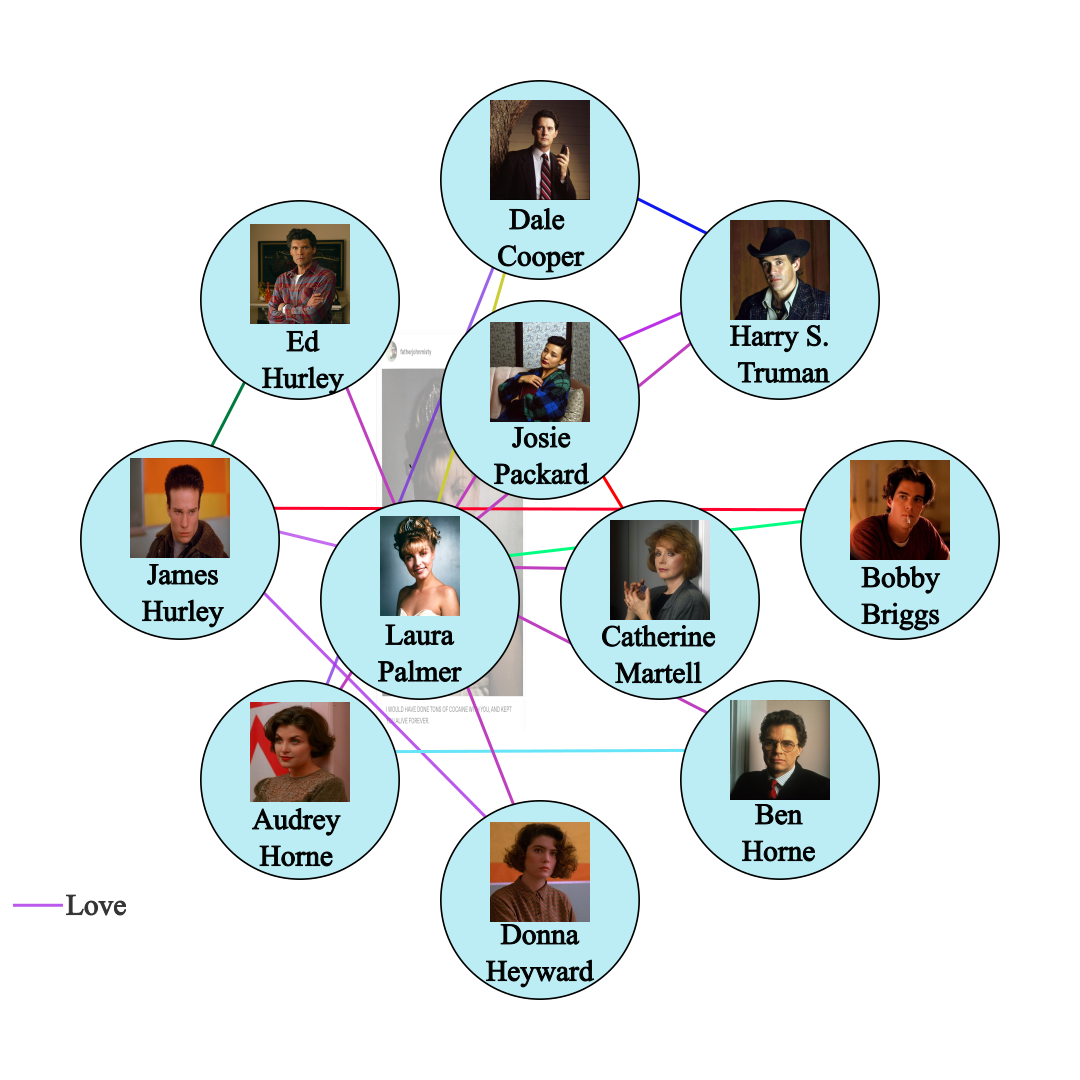
For a more succinct breakdown of the romantic relationships in Twin Peaks, please refer to the handy, provided chart below:
Final Thoughts and Summary:
As I watch Twin Peaks, particularly in the wake of David Lynch's death, I find myself thinking of partnership between director and actor: De Niro and Scorsese, Wes Anderson and any number of goofballs, David Lynch and Kyle MacLachlan. What enormous faith and what beauty to find someone who you can trust so completely, so fully, to embody an artistic vision. How that relationship must grow, and evolve over time. Can the director keep the actor a real person, in their mind, or do they become some puppet, poseable and controllable. Is it the relationship between god and creation? father and son? artist and sculpture? Can these two, who must understand one another implicitly, truly love each other?
At first, Twin Peaks felt like a stilted, near-end-of-the-cold-war comment on American culture. A decaying, radioactive soviet fever dream of what life must be like in America. An idyllic top layer of high-school sweethearts and football games, of friendly mechanics and diners with otherworldly pie, school yard beefs between jocks and rowdy motorcycle gangs. A veneer which covers a deeper rot of drugs and sex and violence, of senseless murder. A deeper level of culture which must exist, because it already does. Each American Archetype: The Football Captain, The Prom Queen, The Long-Arm-Of-The-Law all twisted in upon themselves, split nearly in two. These characters living dual lives, serving dual roles, only one of them true.
As the series progresses, though, its roots as a soap opera come forward, after all, the only thing ever playing on a TV in Twin Peaks is a day-time soap opera. Twin Peaks is a soap opera, one that is forced to live in a world of cause-and-effect. A soap opera where the events have weight, the many, necessary affairs can destroy lives, nothing really changes, and people stay dead. Melodrama elevated and given consequence. The people of Twin Peaks are living by a set of rules and logic that they do not understand, that they try constantly to intuit, but cannot. Because in this world, God is the The Plot, and like in all soap operas, the plot is self-propelled, and will use whatever is necessary to further itself. Where will the plot go, as inevitably it has to become stranger and stranger to sustain itself. Twin Peaks is about living under some great, unseen beast which dictates every part of your existence. A beast which must be starved to be escaped, but which feeds itself at your own expense. An overbearing guest which cannot be asked to leave, because this is Its home, actually.
If you'd like to support this project, and receive access to the original notes these are based on, please subscribe to the patreon.